


Published on October 16, 2026
How Moss Damages Your Roof and How to Get Rid of It Safely
If you live in Clark County, you’ve seen it. That soft green carpet that creeps across the north side of the roof every winter. It looks harmless, and some folks even think it’s kind of charming. But moss on a roof is a lot like a slow leak. It doesn’t seem like a big deal until it suddenly is.
Here’s the short answer: yes, moss damages your roof, and Vancouver’s climate is close to perfect for growing it. The good news is that roof moss removal doesn’t have to beat up your shingles. Done the right way, it kills the moss at the root, keeps your roof’s protective layer in place, and buys you years of extra life.
Below, we’ll walk through why moss loves our roofs, what it actually does to your shingles and decking, the safest ways to remove it, and a simple schedule to keep it from coming back.
Why Do Vancouver Roofs Grow So Much Moss?
Moss needs three things: steady moisture, shade, and something to hold onto. Southwest Washington hands it all three on a silver platter.
We get over 40 inches of rain a year
Vancouver averages about 42 inches of rain a year, spread over roughly 163 days with measurable rain (Visit Vancouver WA, NOAA 1991 to 2020 normals). That’s not big storms followed by dry spells. It’s months of drizzle, fog, and damp air from October through spring. Your roof barely dries out between rains, and moss loves that.
The winter sun sits low and weak
At our latitude, the midday sun in late December only climbs about 21 degrees above the horizon. That low angle means north-facing roof slopes can go weeks without any direct sunlight. Even south slopes get shaded by trees, chimneys, and neighboring houses. No sun means no drying, and shaded sections are almost always where moss shows up first.
Douglas firs drop debris all year
Those big, beautiful Douglas firs are part of what makes living here special. They also shed needles, cones, and small branches onto your roof year-round. That debris piles up in valleys, behind chimneys, and in gutters. It holds water like a sponge and breaks down into a thin layer of organic matter. That’s basically potting soil for moss.
Other things that make it worse
- Overhanging branches that block light and drip water long after the rain stops
- Clogged gutters that let water back up under the first row of shingles
- Poor attic ventilation that keeps the roof deck cooler and damper
- Older shingles that have lost granules and have rougher surfaces for spores to grab onto
How Does Moss Actually Damage a Roof?
Moss doesn’t punch holes in your roof overnight. It works slowly, in three main ways. Once you see how it happens, it’s easy to understand why roofers take it seriously.
1. It lifts your shingles
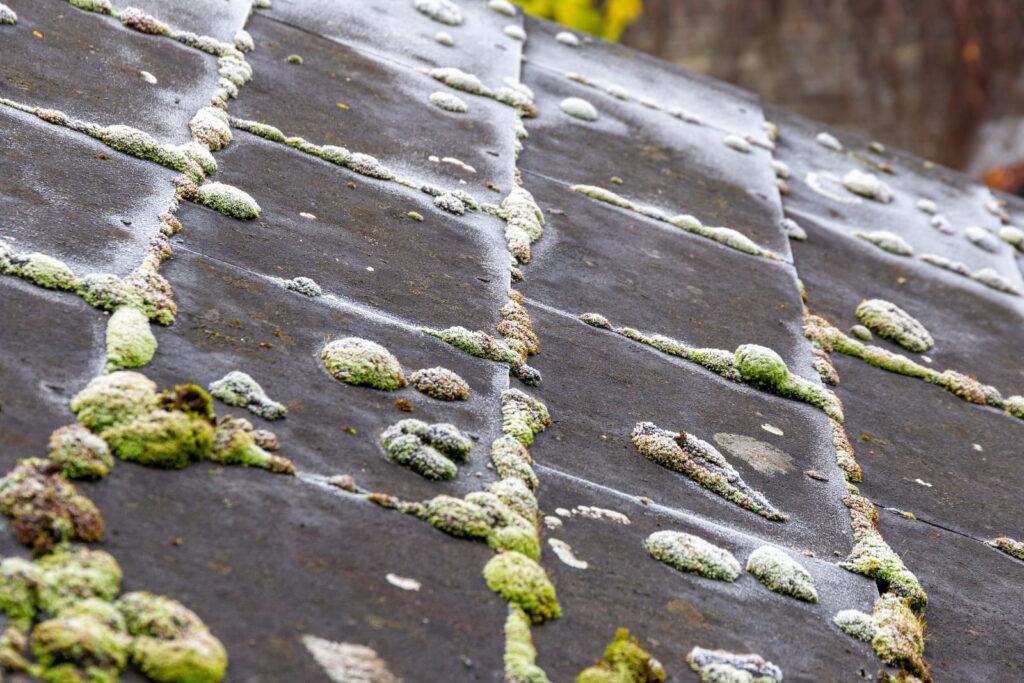
Moss spores land in the small gaps where shingles overlap. As the moss grows, it gets thicker and pushes up on the shingle above it. Over time, the shingle edges curl or lift. Once they’re lifted, wind can get underneath and tear them loose, and rain can blow right up into the gap.
2. It traps moisture against the roof
A thick patch of moss soaks up water like a kitchen sponge and holds it for days. That means the shingles under it stay wet long after the rest of the roof has dried. Constant moisture breaks down the asphalt and loosens the granules, the little rock-like bits that protect shingles from the sun. If you’re finding granules in your gutters or at the bottom of your downspouts, that’s a sign your shingles are wearing out.
Trapped water also wicks sideways and upward under the shingle laps. That’s how a roof that “looks fine” from the ground can still let water reach the layer below.
3. It speeds up rot in the roof decking
Under your shingles is a layer of plywood or OSB called the sheathing, or roof deck. It’s built to stay dry. When moss keeps forcing water past the shingles, that wood stays damp, softens, and starts to rot. Soft spots, sagging, and stains on your attic ceiling are usually the first clues. By that point, the fix is no longer a cleaning. It’s replacing boards, and sometimes a section of the roof.
Bonus damage: gutters and fascia
Moss and fir needles wash into your gutters and clog them. Water then overflows behind the gutter and soaks the fascia boards and the roof edge. That’s a common spot for rot on older Vancouver homes.
Signs It’s Time for Roof Moss Removal
You don’t need to climb up there to check. Most of these you can spot from the yard or the attic:
- Green or yellow-green patches, especially on north-facing slopes or under trees
- Moss growing in the seams between shingles, making the rows look puffy or uneven
- Shingle edges that look curled or lifted
- Granules piling up in gutters or at the bottom of downspouts
- Gutters that overflow even when they were recently cleaned
- Water stains, damp insulation, or a musty smell in the attic
- Dark streaks along with the moss, which is usually algae (here’s how to deal with those black streaks)
If you’re seeing more than one of these, it’s worth booking a professional roof inspection before you treat anything. A good roofer will check whether the moss has already caused damage under the surface, so you’re not just cleaning over a problem.

Roof Moss Treatment Options Compared
There’s more than one way to get moss off a roof, and they aren’t all equal. Some kill it, some just knock it loose, and a couple can do more harm than the moss itself. Here’s how the common options stack up:
| Method | How it works | Gentle on shingles? | Kills moss at the root? | Best for | Watch out for |
|---|---|---|---|---|---|
| Professional soft wash | Low-pressure spray of a moss-killing solution, then a gentle rinse | Yes | Yes | Most asphalt shingle roofs with light to heavy moss | Needs trained crews who protect plants and gutters |
| Pressure washing | High-pressure water blasts moss off | No | No, spores and roots stay behind | Driveways and concrete, not roofs | Strips granules, forces water under shingles, can void warranties |
| Hand scraping or stiff brushing | Moss is scraped or scrubbed off by hand | Not really | No | Small spots on a low-slope roof | Tears granules and shingle edges, high fall risk |
| Store-bought granules or powder | Sprinkled on moss and activated by rain | Mostly | Partly | Light growth, spot treating | Uneven coverage, can stain roofs and gutters |
| Store-bought spray treatments | Hose-end or pump spray applied by the homeowner | Mostly | Partly | Light growth on easy-to-reach roofs | Hard to apply evenly, still means climbing a ladder |
| Zinc or copper strips | Rain carries zinc or copper particles down the roof, killing moss and slowing new growth | Yes | Over time, below the strip | Ongoing control after a cleaning | Slow on thick moss. Zinc lasts about 5 to 8 years, copper a few more |
Zinc strips deserve a special mention because we get asked about them a lot. When rain hits the strips, it carries zinc or copper particles down the roof, and those particles do a good job of killing moss. Copper covers more area than zinc. Either way, they work best once the roof has been cleaned, because thick moss takes a long time to die off on its own. If you’re deciding which kind to use, we compare them in zinc vs. copper roof strips.
Why a Soft Wash Is the Gentle Choice for Your Shingles
If you remember one thing from this post, make it this: don’t let anyone pressure wash your asphalt shingle roof. The Asphalt Roofing Manufacturers Association (ARMA) recommends a low-pressure cleaning method instead, and major shingle makers warn against high-pressure washing in their care guidelines.
Here’s how a soft wash works:
- Protect the property. Plants, siding, and walkways get wet down or covered so runoff doesn’t hurt them.
- Apply the treatment at low pressure. The spray comes out at about the same pressure as a garden hose. It soaks into the moss instead of blasting it.
- Let it work. The solution kills the moss, roots and all. Dead moss turns brown or tan and lets go of the shingles.
- Clear the loose growth. A light rinse or blower removes what comes off easily. The rest weathers away over the next few rains.
- Clean up. Gutters and downspouts get cleared so dead moss doesn’t clog them.
The big difference is that a soft wash goes after the living moss, not the surface of your roof. Pressure washing does the opposite. It knocks off the visible green stuff, leaves spores behind, and takes your shingle granules with it. That’s why moss often comes back faster after a pressure wash.
So if you’re wondering how to remove moss from your roof without damaging the shingles, this is how. Low pressure, the right solution, and a little patience.

DIY Roof Moss Removal vs. Hiring a Pro in Washington
We get it. A jug of moss killer from the hardware store costs a lot less than a service call. For a small shed or a low, single-story garage, DIY can work. For most homes, though, the risks add up fast.
Falls are the biggest risk
A mossy roof is slick even when it’s dry, and in Vancouver it’s rarely dry. Wet moss on a sloped roof is about as slippery as ice. Ladders on soggy lawns shift. If you fall, you’re dealing with the injury and the medical bills on your own.
Hiring a cheap “moss guy” can put the liability on you
Here’s the part a lot of Washington homeowners don’t know. If you hire someone who isn’t a registered contractor, Washington L&I says you could be treated as that person’s employer. That can include workers’ comp and safety requirements. L&I also warns that most homeowner policies don’t cover workers. So if an unregistered worker falls off your roof, you could be on the hook (Washington L&I, Hiring a Contractor). Before you hire anyone, look them up with L&I’s free Verify a Contractor tool.
The wrong method can put your shingle warranty at risk
Shingle warranties generally don’t cover damage from improper care. Pressure washing, hard scraping, and walking on fragile, mossy shingles can all strip granules and crack shingle edges. If you ever need to file a warranty claim, that kind of damage can work against you. Check your warranty paperwork before trying anything yourself.
Quick comparison
| What matters | DIY | Professional |
|---|---|---|
| Safety | You’re on a wet, slick roof, often without harnesses or roof anchors | Trained crews with proper fall protection |
| Liability | Your injury is on you, and an unregistered helper’s injury may be too | Registered, bonded, insured contractor carries the risk |
| Shingle damage | High risk with scraping, stiff brushes, or pressure washers | Low-pressure soft wash protects granules |
| Warranty | Improper cleaning can hurt a future claim | Methods line up with manufacturer care guidelines |
| Results | Often kills surface moss only, so it comes back quickly | Kills moss at the root for longer-lasting results |
| Spotting hidden damage | Easy to miss lifted shingles or soft decking | Roofer checks shingles, flashing, and decking while up there |
| Upfront cost | Lower | Higher, but it can save you from repairs later |
A Simple Moss Prevention Schedule for Vancouver Homes
Getting moss off is half the job. Keeping it off is the other half. This schedule is built around our wet season, our fir trees, and our short winter days:
| When | What to do | Why it matters |
|---|---|---|
| October to November | Clear needles and leaves off the roof and out of gutters after the big fall drop | Removes the wet debris moss uses as a starter bed |
| December to February | Check from the ground after windstorms for fallen branches and debris piles | Catches problems before they hold water all winter |
| March to April | Look for new green growth on north slopes and shaded spots. Treat if needed | Moss grows fast in the cool, wet spring |
| May to June | Clear away dead moss after treatment and clean gutters again | Keeps dead moss from clogging drains |
| July to September | Trim overhanging branches, install zinc strips, and handle any repairs | Dry weather is the best time for roof work |
| Once a year | Get a professional roof inspection | Spots lifted shingles, worn flashing, and early rot |
| Once or twice a year | Professional roof cleaning with a soft wash, more often under heavy tree cover | With constant fir debris, regular cleaning is the only real way to stay ahead of moss |
Wondering exactly when to schedule treatment? We break it down in the best time of year to remove moss from your roof. For the bigger picture on keeping your whole roof healthy, check out these roofing tips for homeowners.
Roof Moss FAQs
Is moss on my roof really that bad?
Yes. A little moss isn’t an emergency, but it doesn’t stay little in Vancouver. It lifts shingles, holds water against your roof, and can lead to rot in the decking. The sooner it’s treated, the cheaper the fix.
Can I just pressure wash the moss off?
We don’t recommend it. Pressure washing strips the protective granules off asphalt shingles, can force water under them, and leaves moss spores behind. A low-pressure soft wash is the safer way to go.
Do zinc strips get rid of moss?
They help. As rain washes zinc particles down the roof, they kill moss and slow new growth. They work best on a clean roof, so heavy moss should be treated first. Zinc strips usually last about 5 to 8 years, and copper lasts a few years longer.
How long does it take for moss to fall off after treatment?
The moss usually dies and changes color within a few days. Most of it loosens and washes away over the next several weeks of rain. Thick patches may need a light cleanup pass.
Will the moss come back?
In our climate, it can. Shade, rain, and fir debris don’t go away. Regular gutter cleaning, trimming branches, zinc strips, and cleaning your roof once or twice a year go a long way toward keeping it off.
How much does roof moss removal cost?
It depends on your roof’s size, pitch, how heavy the moss is, and whether there’s any damage underneath. The easiest way to know is to get a free estimate.
Should I remove moss before selling my house?
It’s a good idea. Buyers and home inspectors notice moss, and it can raise questions about the roof’s condition. A clean roof that’s been checked by a roofer makes for a smoother sale.
Get Safe, Gentle Roof Moss Removal in Vancouver, WA
Moss is part of life in the Pacific Northwest, but roof damage doesn’t have to be. At Warner Roofing & Construction, our soft wash treatment kills moss at the root without blasting away the granules your shingles need. Our crews are trained, insured, and know how to work safely on wet, steep roofs, so you don’t have to.
While we’re up there, we’ll keep an eye out for lifted shingles, worn flashing, and soft spots, and we’ll tell you honestly what we find. If your roof is in good shape, we’ll say so. If it needs attention, we’ll walk you through your options in plain language.
Ready to get the moss off for good? Request your free estimate and we’ll help you keep your roof in great shape for years to come.